Showing posts with label potato dextrin resist. Show all posts

Tuesday, May 1, 2012

Working With Resists - Potato Dextrin

It took a few years for me to really appreciate potato dextrin. It is best known for its distinctive crackle pattern, however I have found that it can be very versatile. It works well in a squeeze bottle, stamped or stenciled, brayer printed and even screen printed. It washes out easily but it can withstand low water immersion. The main downside is that it is more costly than other paste resists. Covering a large piece of cloth for the crackle effect can get expensive. But it does look fabulous!


Here is the classic crackle pattern. The dextrin was applied unevenly, resulting in some areas with fine cracks and some areas with larger cracks.


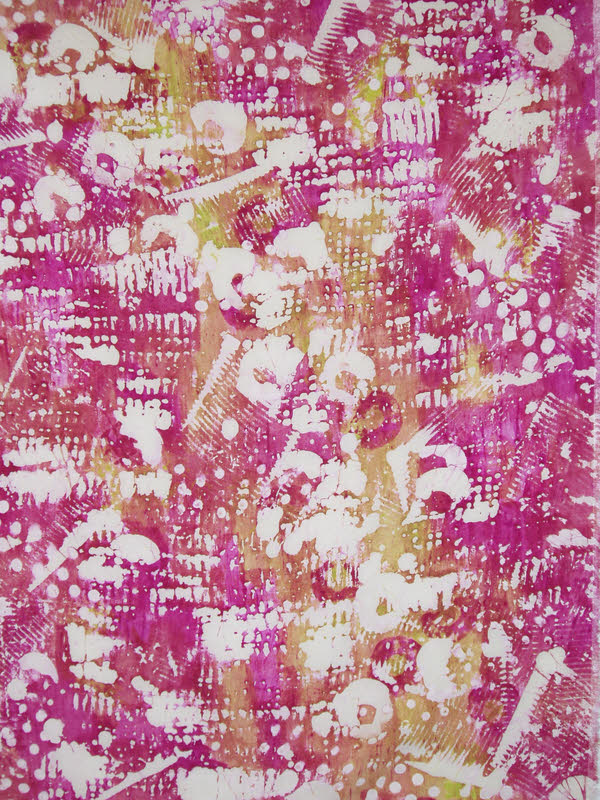
Potato dextrin was brushed through a plastic grid, then painted with thickened dye. When using objects as stencils, the result is not always as expected. Instead of creating neat squares, the dextrin pooled around the grid, resulting in this abstracted pattern.


Potato dextrin brushed through lace curtain, painted with thickened dye.  Prior to being used as a stencil, the lace was stiffened with a coating of acrylic paint.


Potato dextrin applied with a brush, painted with thickened dye


Potato dextrin applied with a sponge stamp, painted with thickened dye.


Potato dextrin applied with a sponge stamp, immersed.  Notice how more of the dye breached the resist, resulting in a softer image.


Potato dextrin brayer print with a chocolate box liner underneath the cloth.


Potato dextrin applied with a circular brush.


Read my tips for working with resists

Read about working with sugar syrup resist

Read about working with acrylic medium resist


Read about working with flour paste resist

Read about working with oatmeal resist

Read about working with soy wax resist

Tuesday, March 13, 2012

Working with Resists - Tip #2


#2 Try a variety of approaches
 
When I started working with resists I tended to stick to the mainstream.  Flour paste and potato dextrin were used to create the crackle effect, gel glue was used for screenprinting and food items such as grits, oatmeal and honey were used for breakfast. It is easy to limit ourselves to one or two common techniques, yet resists are so versatile, it's a shame not to take advantage of their full potential. In my experimentation, I discovered that potato and corn dextrin can be applied with a silk screen, flour paste works great when stamped on and soy wax can be applied with a stencil. Below are photos of a few variations on the traditional.


Potato dextrin dripped from a spoon
The dark spots in the center of the drips were a pleasant surprise.  The dextrin cracked and some of it fell off the cloth, resulting in that patterning.

Potato dextrin brushed through hardware cloth
Hardware cloth is a plastic grid, available at home improvement stores.  It is useful for a lot of surface design techniques.  Here, the plastic was placed on top of the fabric, and the dextrin was brushed over the top.

Flour paste monoprint
Flour paste was applied to a plexiglas surface, then the cloth was placed on top of it, transferring the flour to the cloth.

Oatmeal
Rather than applying oatmeal to the entire cloth, circles (where the labyrinths are screen printed) were blocked off with freezer paper.

Read Tip #1

Read Tip #3

Read about working with sugar syrup resist  

Read about working with acrylic medium resist

Read about working with flour paste resist

Read about working with oatmeal resist

Read about working with potato dextrin resist

Read about working with soy wax resist

Friday, July 29, 2011

Finishing Some Things

Last week I spent some time finishing up a number of pieces.  These are pieces that were started last fall. I felt they all had potential, but was stuck on exactly what to do.  Nothing like a six month break to bring a new perspective.

This piece was created with soy wax resist and was one in a number of studies I did on complementary colors. Here is the before version. Interesting, but no focal point.


After a few layers of dye and handpainting, here is the finished piece.


This piece was created using sugar syrup resist. Here is the before version. 


I wasn't thrilled with the composition, so I cut it up, discharged some of it, dye-painted some areas and put it back together.


This last piece is another complementary color study and was created by brushing potato dextrin through plastic hardware cloth. The before version:


Again, not a strong enough focal point. I decided to cut this down and put it on a 12" x 12" canvas and add some contrast with paint and metal leaf.


Sunday, September 12, 2010

Fat Quarter Studies, Part 2

I've been working on the rest of the fat quarter studies as part of my artcloth mastery class assignment.  These are a series of 8 pieces in which I am using a similar composition, trying different techniques to decide what I want to do for a series of larger pieces. All of the pieces incorporate the use of resists and handpainting.  All of these need a bit more work - some just a little touch of metal leaf, some a lot more!   But, it's time to put them aside for now and start on the larger pieces.

Below are photos of the remaining five pieces in the series.  I posted photos of the
first three a few weeks ago.   


This is my favorite of this batch.  I used a potato dextrin resist on silk/soy fabric, along with handpainting and discharge. I'm planning to add a little metal leaf as well.


This piece started with a sugar resist on silk/soy, painted while wet, followed by a flour resist. To create additional depth in the background,  I added a few layers of handpainting with thickened dye.


This is silk broadcloth, with potato dextrin brushed through a plastic grid, then handpainted.


This is another silk/soy with a sugar resist.


This started with soy wax resist, then several layers of handpainting. This still needs a bit more. I have some ideas, just not enough time!

Monday, August 16, 2010

Potato Dextrin Resist

I've been working a lot with different resists over the past few years and wanted to revisit potato dextrin.  I first used it about six years ago and loved the crackle pattern it produced. I have also experimented with mashed potato flakes, because they are inexpensive and easy to obtain - no shipping charges!  I've been using flour paste to get a crackle pattern lately, so I wanted to play around with the dextrin again. 

Below are a few photos from my experiment last week.  For the mashed potato flakes I used about 1/2 cup potato flakes to 1 cup hot water.  For the dextrin, I used about 1 1/3 cup dextrin to 1 cup hot water.  I spread the paste on with a squeegee and used the sgraffito technique to scratch into the wet paste.  After the paste had dried, I applied thickened dye.


This shows the mashed potato flakes using the sgraffito technique.  I scratched into it with a bamboo skewer and placed a lace doily, bubble wrap and a rubber rug gripper on for texture.


Another example of mashed potato flakes applied with a squeegee.


This is potato dextrin, applied with a squeegee and then I embedded objects in the moist paste to create pattern and texture.  I didn't get the nice crackling I expected, nor much patterning, but I blame my impatience.  I applied the dextrin while it was still hot.  It needs to cool somewhat before using so it thickens properly. It went on as a very thin coating, which didn't crack much when dried.


This is also potato dextrin. I stamped it on and applied it with a brush.  I had forgotten how well it works as a resist when stamped onto the fabric.


I am currently doing some fat quarter studies, layering different resist techniques.  This is one of the studies using potato dextrin.  I brushed the dextrin through a large plastic grid. I left the grid on until the dextrin had partially dried.  Very interesting!  Today I'll work on the next layer of color.


Related Posts Plugin for WordPress, Blogger...